
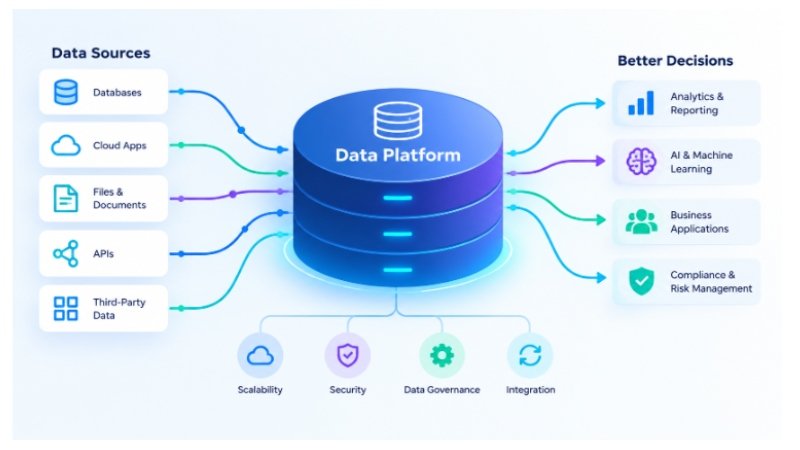
Businesses collect data from many different sources. Customer records, transactions, websites, applications, and internal systems can all produce useful information. Managing this data becomes difficult when it remains spread across separate systems. A data platform brings different data processes into a more connected environment. It can support data collection, storage, processing, integration, analysis, and governance. This helps businesses create a more consistent view of their information. For financial institutions, better data management can also support AML processes. Connected data can help compliance teams review customer information, screening results, and transaction activity with more context.
What Is a Data Platform?
A data platform is a technology environment that involves the collection, management, storage, processing, and analysis of data across various sources. A data platform can centralize these processes, rather than having all information in isolation. This can lead to a decrease in data silos and improve information accessibility. Modern platforms can also enable data transformation, analytics, governance, and real-time processing. The specific characteristics will vary based on the platform and the business requirements. This kind of arrangement may help AML teams when there is more than one information source. When standardized, integrated data is correctly linked, it can offer a clearer picture of customers, screening data, transaction records, and risk information.
What Is a Customer Data Platform?
A customer data platform focuses specifically on customer information. It aggregates data from multiple sources and forms a single customer perspective. For instance, data may come from a CRM, website, transactions, or other customer interactions. The platform then brings this information together into a more consistent profile. This can help businesses that need a clear understanding of their customers. In the financial services sector, customer data may also help in the process of onboarding, monitoring, and risk evaluation. But a customer data platform is not a customer AML screening system. It is all about customer information management, whereas AML tools are about identifying and evaluating financial crime risks.
What Is a Data Management Platform?
A data management platform enables companies to structure and manage information. It can be used to facilitate data collection, storage, transformation, quality management, and governance. Its primary role is to improve the reliability and usability of data. When data is not managed properly, this can lead to inconsistencies between systems. This may impact data reporting, analytics, and business decisions.
The process of handling data in a strong way also assists organizations in setting up sound controls over data storage and use. Reliable data is of particular importance for compliance teams. Incomplete customer information can make screening and investigation more difficult.
What Is a Data Integration Platform?
A Data integration platform is a software system that links data from various systems and sources. It enables transfer and fusion of information for teams to collaborate with a unified perspective. Data integration can enable the linkage of data from databases, applications, cloud services, and other data sources. The idea is to minimize the need to operate on isolated data. This can be especially beneficial for financial institutions. Customer information might be in one system, transaction records in another, and compliance results in yet another. The synthesis of the relevant information can facilitate the analysis of relationships between various risk signals. FATF also emphasizes the importance of data pooling, collaborative analytics, and advanced analytics for enhancing AML/CFT capacities.
How Can Data Platforms Support AML Compliance?
Gaining access to valuable and credible information is key to AML compliance. Data is used for customer due diligence processes, screening, transaction monitoring, investigations, and more. A connected data environment can help you realize these sources. This will provide the compliance team with more context when they are considering potential risks. In particular, FATF has examined how big data and advanced analytics can help financial institutions detect patterns and trends associated with money laundering and terrorist financing. It also recognizes the potential of improved data use to narrow information gaps among institutions. A data platform is not a replacement for AML controls. Rather, it can provide a basis for implementing information more effectively across those controls.
Bringing Data Together for Stronger AML Decisions
Good AML decisions depend on more than having large amounts of data. The information also needs to be connected, relevant, and usable by compliance teams. AML Watcher brings sanctions screening, PEP screening, adverse media screening, transaction monitoring, and ongoing monitoring into one connected AML workflow. This helps teams review different risk signals in one place and build more context around potential threats. For businesses managing complex customer and transaction data, a connected approach can make AML investigations more focused and manageable. Explore AML Watcher to see how integrated screening and monitoring can support stronger risk decisions.