
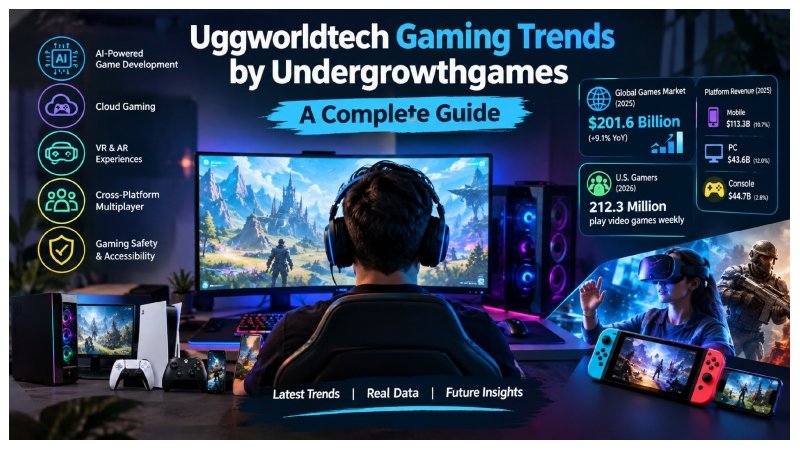
The gaming industry is growing rapidly, driven by artificial intelligence, cloud gaming, mobile technology, and immersive experiences. According to Newzoo, the global games market generated an estimated $201.6 billion in revenue in 2025, highlighting the industry’s enormous economic impact. But what gaming trends will shape the experiences of players in 2026 and beyond? Uggworldtech Gaming Trends by Undergrowthgames explores the technologies, platforms, and innovations transforming modern gaming. From AI-powered development and cross-platform multiplayer to esports, accessibility, and online safety, these developments influence how people play and connect.
This guide examines key trends using industry data and reliable references to help readers understand what’s changing and what gamers can realistically expect next.
What Are Uggworldtech Gaming Trends by Undergrowthgames?
Uggworldtech Gaming Trends by Undergrowthgames is a topic focused on gaming technology, player experiences, and changes across the gaming industry. It provides a starting point for exploring developments such as AI-assisted game creation, cross-platform multiplayer, cloud gaming, virtual reality, and online communities.
The Uggworldtech gaming trends article is a relevant starting point for readers researching this subject. However, industry statistics and technical claims should also be checked against independent sources.
Gaming is no longer limited to a particular age group. The Entertainment Software Association’s 2026 Essential Facts report estimates that 212.3 million Americans play video games weekly. It also reports that 67% of Americans aged 5–90 play for at least one hour per week.
These figures illustrate the widespread appeal of gaming in the United States. They also show why accessibility, different difficulty levels, social features, and device compatibility matter to developers.
Top Gaming Technology Trends in 2026
Several technologies are influencing how developers build games and how players experience them. AI-assisted production, cloud gaming, improved graphics, and immersive hardware are among the important developments to watch.
AI-assisted game development
AI tools can help development teams with coding assistance, testing, content planning, and repetitive production tasks. These applications may allow developers to spend more time refining gameplay and creative ideas. However, AI-generated content still requires human review for quality, originality, and accuracy.
Datatonic’s analysis of gaming trends discusses AI-assisted design, code generation, and automated quality assurance as emerging areas of development.
Cloud gaming
Cloud gaming runs supported games on remote servers and streams the output to a player’s device. This approach can reduce the need for powerful local hardware, although it does not remove every technical requirement.
Players still need a suitable internet connection, a compatible device, and access to the relevant service. Latency, data limits, regional availability, and subscription costs can affect the experience.
VR and AR gaming
Virtual reality places players inside simulated environments, while augmented reality adds digital elements to the physical world. These technologies can create new ways to explore, interact, and solve problems.
The Aethir gaming trends analysis identifies AI, VR, AR, and cloud gaming among technologies that may shape future experiences. Their adoption will depend on hardware costs, useful game content, comfort, and player demand.
Cross-Platform Gaming and Multiplayer Experiences
Cross-platform play allows people using different supported devices to participate in the same multiplayer game. For example, a PC player may join a friend on a console when the game supports both platforms.
Cross-progression offers another benefit by allowing certain progress or unlocked items to carry across compatible devices. These features can make gaming more flexible and help friends stay connected even when they own different hardware.
The ESA’s 2026 report provides useful evidence of gaming’s social role. It found that 89% of surveyed players had played games online, while 55% of all players played with others weekly. The report also found that 78% of Gen Z respondents believed gaming helped bring people together and build relationships.
These are U.S. survey findings rather than worldwide estimates, but they demonstrate how multiplayer gaming can support social interaction.
Developers must still address practical challenges. Different control systems can affect competitive balance, while cheating, harassment, and account security can undermine the experience. Effective matchmaking, reporting tools, moderation, and privacy settings are essential for healthier gaming communities.
Gaming Devices, Streaming, and Esports
Gaming is spread across mobile phones, PCs, consoles, and handheld devices. Each platform offers different advantages in portability, performance, price, and available games.
Newzoo’s analysis of 2025 gaming revenue provides a useful comparison:
| Gaming platform | 2025 global revenue | Annual growth |
|---|---|---|
| Mobile | $113.3 billion | 10.7% |
| PC | $43.6 billion | 12.0% |
| Console | $44.7 billion | 2.8% |
| Total | $201.6 billion | 9.1% |
These figures show that mobile generated the largest share of gaming revenue, while PC recorded the strongest annual growth among the three platforms. Revenue, however, does not measure player numbers directly, and growth rates do not guarantee future performance.
Streaming and esports also contribute to gaming culture. Streamers share live gameplay, reviews, walkthroughs, and tutorials. Esports introduces structured competition through teams, leagues, and tournaments.
For players choosing equipment, the best option depends on their preferred games, budget, storage needs, internet connection, and desired performance. Expensive hardware is not always necessary, particularly for casual and mobile gaming.
How AI Is Changing Game Development
AI is becoming a useful tool for certain game-development tasks. Developers can use it to assist with programming, generate early design concepts, identify potential software errors, and test different gameplay situations.
AI may also support more responsive non-player characters (NPCs). Depending on the implementation, characters could react to different player actions or offer more varied interactions. Procedural content generation can help create environments, missions, or other game elements, although human direction remains important.
Datatonic’s 2026 analysis discusses AI-assisted workflows, faster development tasks, and automated testing. These applications can help teams investigate production problems and iterate on designs, but actual results vary between studios and projects.
There are also important limitations. Poorly reviewed AI-generated content can introduce errors, repetitive dialogue, or inconsistencies. Developers must consider intellectual property, data privacy, transparency, and the quality of the final experience.
For players, the key question is not whether a game uses AI, but whether its implementation makes the game more enjoyable, responsive, or accessible.
Gaming Monetization, Accessibility, and Player Safety
Gaming companies use different revenue models, including paid games, subscriptions, downloadable content, advertisements, and optional in-game purchases. These models affect how players access content and how publishers earn revenue after launch.
The ESA’s 2026 report found that 58% of surveyed players had downloaded a free game during the previous 12 months, while 43% had purchased a game and 35% had purchased a gaming subscription. These categories can overlap because a person may use several purchasing methods.
The report also found that players from Gen Alpha, Gen Z, and the Millennial generation who purchased in-game content typically spent a median of $20 per month. This is a reported median for those groups of purchasers, not an estimate of spending by every gamer.
Accessibility is another important consideration. Subtitles, remappable controls, adjustable text, color options, and difficulty settings can help more people enjoy games.
Players should review prices before purchasing digital items and use parental controls where appropriate. Strong passwords, two-factor authentication when available, and caution around suspicious links can also protect gaming accounts.
A successful gaming experience requires more than advanced graphics. Fair monetization, accessible design, privacy, and reliable moderation all contribute to player trust.
What Players Can Expect From Gaming in the Future
Gaming is likely to continue developing through advances in AI, online services, hardware, and user-generated content. However, forecasts should be distinguished from confirmed results.
Newzoo’s June 2026 analysis projects that the global gaming market could reach $234.4 billion by 2028, based on an expected compound annual growth rate of 5.1% from 2025 to 2028. This is a forecast, not a guaranteed outcome.
The same analysis highlights differences between platforms. Mobile remains a major revenue source, PC has benefited from strong premium releases, and console performance depends partly on hardware cycles, major game launches, and subscription spending.
Future developments may include more sophisticated AI tools, improved multiplayer systems, and new ways to create and share game content. Cloud services could broaden access to certain titles, while VR and AR may appeal to players seeking more immersive experiences.
Nevertheless, costs, internet infrastructure, privacy concerns, and player preferences will influence adoption. Gamers should compare actual features, supported devices, service terms, and independent reviews rather than relying on promotional claims.
Conclusion
Uggworldtech Gaming Trends by Undergrowthgames provides a useful topic for examining the technologies and business developments influencing gaming in 2026. Verified market data shows that gaming is a substantial global industry, with mobile, PC, and console platforms each contributing significantly.
AI-assisted development, cross-platform play, streaming, accessibility, and cloud gaming offer opportunities, but their benefits depend on implementation and player needs.
The most practical approach is to follow credible sources, evaluate new features carefully, manage spending, and protect personal accounts. Understanding the evidence behind gaming trends helps players make better decisions and gives readers a clearer picture of where the industry may be heading. See more