
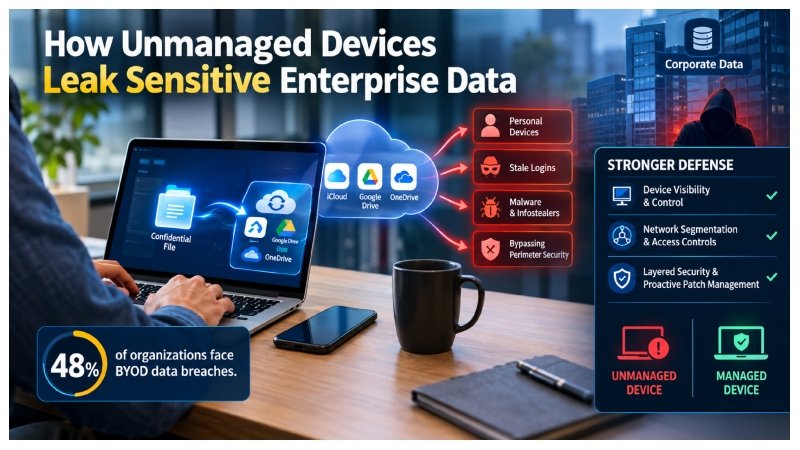
Unmanaged devices leak sensitive enterprise data because they operate outside IT oversight, relying on unsecured background processes, missing security patches, and exposed access points. As remote work blurs the line between personal and professional technology, organizations face unprecedented vulnerabilities. Research shows 48% of organizations face BYOD data breaches, highlighting the massive scale of this security gap. Understanding exactly how unmanaged devices leak sensitive enterprise data gives IT directors the insight needed to implement effective controls without killing employee productivity.
The Hidden Mechanics of Data Leakage on Non-Corporate Endpoints
Data leaves unmanaged devices primarily through routine user behaviors and automated background applications rather than targeted hacking. Silent syncs, persistent stale logins, and the complete bypassing of traditional security tools create a perfect storm for unnoticed and continuous data exfiltration.
Many IT leaders assume that data exfiltration requires a sophisticated cyberattack, but the reality is much more mundane. Routine employee activities on unmonitored devices cause the vast majority of leaks. When a device operates outside of a managed framework, background applications run without restriction and users develop insecure habits.
Three main technical vectors drive this invisible leakage. Silent cloud syncs automatically pull files into personal storage, stale logins leave doors wide open for unauthorized access, and the lack of endpoint detection agents means these activities happen without triggering a single security alert.
How Silent Cloud Syncs Expose Sensitive Files
Background application behaviors inadvertently pull corporate data into unsecured consumer environments. Personal cloud drives sync local folders automatically, silently copying downloaded enterprise files into unmonitored storage. This bypasses your organizational data loss prevention tools completely, creating a massive hidden vulnerability.
Personal cloud storage services like iCloud, consumer OneDrive, and Google Drive are built to provide seamless access across devices by automatically syncing local folders. When an employee downloads a sensitive financial report to a personal laptop, the consumer cloud application immediately copies that file to an external, unsecured server.
This automated process completely bypasses enterprise data loss prevention systems. IT teams have zero visibility into where the file travels next or who can access it. The scale of this behavior is alarming, as 92% of remote workers use personal devices for work, and 46% save work files on them.
Why Stale Logins and Cached Credentials Are Dangerous
Persistent sessions and saved passwords on devices outside IT control create severe security risks. Employees routinely save corporate passwords in personal browsers, allowing malicious software to harvest cached credentials easily and authenticate attackers as legitimate enterprise users without triggering alarms.
Employees working on personal devices often optimize for convenience over security. They tell their personal web browsers to remember corporate passwords and leave active software sessions running indefinitely. This practice creates a goldmine of stale logins and cached credentials that sit unprotected on the local hard drive.
Infostealer malware specifically targets these saved browser caches. Once a personal device is infected, the malware extracts the active session cookies and passwords, granting attackers immediate network access. Data shows that 46% of systems with corporate login credentials in infostealer malware logs were unmanaged devices, highlighting the extreme danger of uncontrolled authentication habits.
Bypassing Traditional Perimeter Security and EDR
Legacy security architectures fail against unmanaged endpoints because these devices lack enterprise monitoring agents. When blind spot devices connect directly to cloud applications or via virtual private networks, they bypass traditional firewalls entirely and render standard perimeter defense models useless.
Traditional cybersecurity relies on an enforced perimeter and deep endpoint visibility, both of which are absent on personal and rogue hardware. Unmanaged devices lack the Endpoint Detection and Response (EDR) agents required to monitor for suspicious activity. They also lack foundational protections like remote wipe capabilities or mandatory full-disk encryption.
When an unmonitored home laptop connects to a corporate network via a basic virtual private network or accesses a cloud application directly, it circumvents the corporate firewall. The enterprise network treats the connection as legitimate traffic, blinding IT teams to any malicious software or data exfiltration happening on the device itself.
How Can IT Teams Regain Visibility and Mitigate Unmanaged Device Risks?
Securing hybrid environments requires a shift away from assumed trust toward continuous verification and multilayered defenses. Establishing centralized visibility, enforcing strict network segmentation, and adopting proactive patch management are the most effective ways to secure endpoints without killing remote worker productivity.
You cannot secure a network if you do not know what is connecting to it. Modern IT security demands a comprehensive strategy that actively manages device access and verifies system health before granting access to corporate data.
Setting up continuous verification works best when endpoint policies are standardized across every operating system, whether someone is logging in from a home office or a client site. Working alongside a managed IT services company helps organizations roll out consistent device compliance checks, routine security patches, and automated access controls. When network boundaries are defined clearly at the endpoint level, employees can access the tools they need securely without triggering constant false alarms or disruptive downtime.
Implement Centralized Endpoint Visibility and Control
Information technology teams must discover and manage rogue devices attempting to access the network. Structured system audits and strict onboarding procedures allow you to accurately document all connected systems and enforce baseline security checks before granting access to corporate resources.
The foundation of endpoint security is absolute visibility. IT departments must implement structured system audits that log every device interacting with the corporate environment. This process identifies shadow IT and unauthorized personal hardware hiding in plain sight.
Organizations need to enforce conditional access policies for all incoming connections. This requires baseline security checks to confirm a device has an updated operating system, an active firewall, and running antivirus software before it can access the network.
Enforce Network Segmentation and Access Controls
Isolating unmanaged devices prevents lateral movement and unauthorized data access across the network. Network segmentation keeps personal hardware and shadow IT from touching core enterprise data repositories, relying on strict credential controls to limit user privileges effectively based on device health.
Network segmentation is a method of dividing a corporate network into isolated subnets to keep personal hardware from touching sensitive enterprise data. If an unmanaged device is compromised, segmentation ensures the malware cannot spread laterally into critical business systems.
Pairing segmentation with identity access management strengthens this barrier. IT teams must implement strict credential controls that limit user privileges based entirely on device health and ownership status. If a device is unmanaged, it receives restricted access only to the non-sensitive applications required for basic productivity.
Adopt a Multilayered Defense and Proactive Patch Management
Proactive security operations and rapid incident response are necessary to stop data exfiltration. A multilayered defense model addresses vulnerabilities across the entire technology ecosystem rather than relying on a single perimeter tool, combining continuous endpoint protection with routine security patching.
Relying on a single line of defense is no longer a viable security strategy. PCPlus Networks advocates for a multilayered defense model that integrates network monitoring, endpoint protection, and user identity verification into a single, cohesive framework.
This approach requires proactive patch management to close known software vulnerabilities before attackers can exploit them. Combined with continuous proactive monitoring, a layered defense allows security teams to detect anomalous behavior on connected devices and isolate compromised endpoints instantly.
Conclusion
Unmanaged devices leak data primarily through silent cloud syncs, cached credentials, and a severe lack of baseline security tools. When employees use personal hardware to access corporate applications, they inadvertently bypass traditional enterprise defenses and expose sensitive files to unauthorized consumer environments. Gaining total endpoint visibility and enforcing multilayered access controls is the only way to protect enterprise data in a modern hybrid environment.