
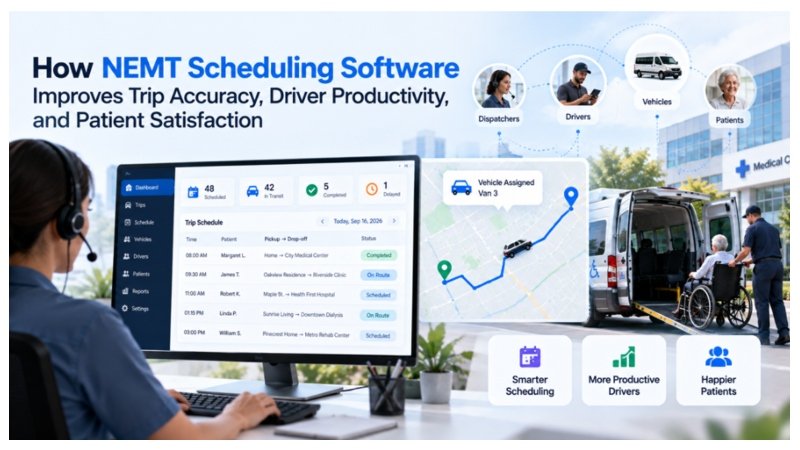
A missed dialysis appointment is more than a scheduling error. It can mean delayed treatment, a frustrated patient, and a compliance headache for the provider footing the bill. NEMT scheduling software exists because manual trip planning breaks down at the volume most providers now handle. A dispatcher juggling spreadsheets and phone calls struggles to track fifty vehicles and two hundred daily trips with real precision. This piece looks at three outcomes that matter most. Trip accuracy, driver productivity, and patient satisfaction all move together when the right software is in place.
Getting Trip Accuracy Right
Trip accuracy sounds simple. Then a dispatcher tries coordinating fifty recurring dialysis rides, a dozen same-day requests, and three wheelchair-accessible vehicles by hand. Errors creep in fast. Each one carries real consequences for a patient who depends on that ride.
Manual scheduling relies on someone remembering vehicle capacity, driver certifications, and appointment windows all at once. A single overlooked detail sends the wrong vehicle to the wrong address. Sometimes it books two patients into one seat. NEMT management software removes that guesswork. It matches trip requirements to vehicle and driver capability automatically.
Same-day and will-call requests test scheduling accuracy the hardest. A hospital discharge often needs a ride within the hour, with no advance warning at all. A platform built for this reality slots urgent trips into the existing schedule without disrupting rides already confirmed for other patients.
- Matches trip type to the correct vehicle category, including wheelchair and stretcher vans
- Verifies driver certifications before a trip gets assigned
- Handles will-call return trips without manual re-entry
- Flags scheduling conflicts before they become missed pickups
Recurring trips deserve particular attention. A patient attending dialysis three times a week needs the same reliable pickup window every visit. NEMT vehicle scheduling software with standing order support removes that daily uncertainty for the patient and the dispatch team alike.
Address accuracy matters just as much as timing. Many platforms now verify addresses against mapping data before confirming a trip. This catches typos and incomplete entries early, well before a driver ends up at the wrong building.
Compliance sits underneath all of this. Every trip record carries protected health information. A provider handling patient pickups and drop-offs needs that data secured throughout the entire trip. Software built for healthcare transportation treats this as a baseline requirement, built in from the start. Healthcare product development can help providers build transportation solutions with security, compliance, scheduling, and patient-management requirements considered from the beginning.
Boosting Driver Productivity
Every minute a driver spends idle between trips is a minute the fleet isn’t earning. Dispatchers working from paper logs or basic spreadsheets routinely leave drivers waiting on assignments that could have gone out sooner.
Automated dispatch changes this directly. NEMT dispatch software assigns the nearest qualified vehicle the moment a new request comes in. No dispatcher has to manually scan a list first. Drivers see their next trip appear on their app, complete with turn-by-turn navigation, often before they’ve finished the current drop-off.
- Assigns trips automatically based on driver location and availability
- Reduces dead mileage between trips through smarter routing
- Gives drivers real-time trip details without a radio call to dispatch
- Tracks earnings and trip history so drivers see their own performance clearly
- Lets drivers toggle availability on and off without calling dispatch directly
Route optimization compounds these gains across a full shift. A driver running eight optimized trips covers noticeably less ground than one running the same eight trips in random order. Multiply that across a fleet of thirty vehicles, and fuel and time savings add up fast within a single month.
Productivity gains extend past the road too. Digital signature capture replaces paper trip sheets, cutting the end-of-shift paperwork that used to eat into personal time. Less friction after the last trip means drivers finish faster. They start the next shift in a better mood too.
Improving Patient Satisfaction
Patients booking NEMT rides are often managing a health condition already. Uncertainty about pickup time adds stress nobody in that position needs. NEMT transportation software addresses this through visibility the patient can see and use directly.
SMS updates with the driver name, vehicle details, and a live tracking link turn an anxious wait into a predictable one. A patient watching their ride approach on a map feels in control. One staring at a silent phone does not.
- Sends automatic SMS alerts with driver and ETA details
- Provides a live tracking link so patients know exactly when their ride arrives
- Offers a direct contact option if plans change or questions come up
- Collects feedback after each trip to catch problems early
- Gives caregivers and family members visibility into a loved one’s ride
Consistency matters as much as any single feature here. A patient who gets the same reliable experience trip after trip builds real trust in the service. That trust shows up in fewer canceled appointments. It shows up in stronger word of mouth too. Reliable transportation often decides whether a patient attends care or misses it entirely.
Dignity plays a role too, one that gets overlooked in most software comparisons. An elderly patient or someone managing a chronic illness deals with enough uncertainty already. A calm, predictable ride removes one more thing to worry about on an already difficult day.
How These Three Outcomes Reinforce Each Other
Trip accuracy, driver productivity, and patient satisfaction rarely improve alone. Fix scheduling accuracy, and drivers spend less time untangling conflicting assignments. Free up driver time through better routing, and dispatchers can accommodate more same-day requests without added strain. Give patients consistent, visible service, and no-shows drop. Late cancellations drop too. That frees up more capacity for other trips that same day.
The NEMT market itself reflects this compounding value. According to a market research report by The Insight Partners, the global NEMT market is projected to reach 15.57 billion dollars by 2028, growing at a compound annual rate near nine percent. That growth reflects a real change in how health systems view transportation, treating it as genuine patient care, woven into the treatment plan itself. Software built around trip accuracy, driver productivity, and patient satisfaction is positioned to capture a meaningful share of that expansion.
Conclusion
Choosing the right platform means testing all three outcomes together as one system. Watch how quickly a new trip gets assigned, and confirm that assignment accounts for vehicle type and driver certification automatically. Check what a patient sees on their phone while waiting.
A short pilot reveals more than any feature list. Run it with one vehicle type or one region first. Measure results against real numbers, on-time pickup rates, missed trip counts, and driver idle time between rides. Providers taking this approach often see the software pay for itself within months, through fewer missed appointments and shorter dispatcher workdays. Treat trip accuracy, driver productivity, and patient satisfaction as one connected system. That is how patients and drivers experience the service daily.