
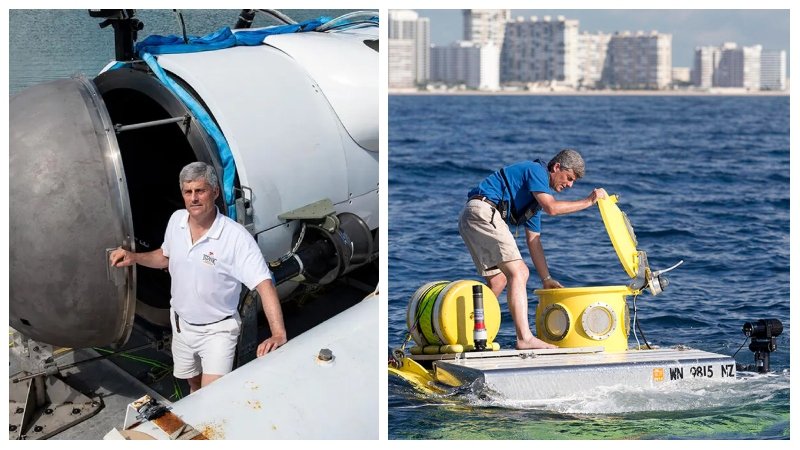
Stockton Rush was an American businessman, pilot, engineer, and deep-sea exploration entrepreneur best known as the co-founder and chief executive officer of OceanGate. His career combined interests in aviation, engineering, and ocean exploration, eventually leading him to create a company focused on bringing people closer to the deep ocean.
Rush became internationally known after the loss of OceanGate’s Titan submersible during an expedition to the wreck of the Titanic in June 2023. He was one of five people aboard the vessel when it suffered a catastrophic pressure-hull failure. Later investigations examined the design, engineering, testing, and operational decisions surrounding the Titan.
Who Was Stockton Rush?
Richard Stockton Rush III was born on March 31, 1962, in San Francisco, California. He later became widely known as Stockton Rush and developed a professional career that crossed several fields, including aviation, technology, and marine exploration.
Rush was particularly interested in exploration and engineering. Before becoming associated with OceanGate, he had experience as a pilot and flight-test engineer and later pursued business interests. His combination of technical education and entrepreneurial ambitions eventually shaped his approach to deep-sea exploration.
He died on June 18, 2023, at the age of 61 while aboard the Titan submersible in the North Atlantic.
Early Life and Family Background
Rush came from a prominent San Francisco family and grew up with an interest in science, aviation, and exploration. His family background included connections to engineering and business, while his education helped prepare him for a career involving technology and entrepreneurship.
Rather than following a conventional business path, Rush developed an interest in aviation at a relatively young age. According to biographical accounts, he obtained a jet transport rating at age 19 and gained experience flying before completing his university education.
This early exposure to aviation appears to have influenced his later interest in technically challenging forms of exploration.
Stockton Rush’s Education and Aviation Career
Rush studied aerospace engineering at Princeton University, graduating in 1984 with a bachelor’s degree. After Princeton, he worked for McDonnell Douglas as a flight-test engineer on the F-15 program. His work included aviation testing and programs associated with the aircraft’s radar and anti-missile systems.
He later earned an MBA from the University of California, Berkeley’s Haas School of Business in 1989. This combination of engineering and business education became an important part of his professional profile.
Rush also continued pursuing aviation interests outside his formal employment. Biographical accounts state that he built a Glasair III experimental aircraft and later constructed a modified Kittredge K-350 two-person submersible, gaining hands-on experience with both aircraft and underwater vehicles.
How Stockton Rush Became Interested in Deep-Sea Exploration
Rush’s interest gradually shifted from aviation toward the ocean. He was an experienced scuba diver and became increasingly interested in exploring underwater environments without relying solely on traditional diving equipment.
His interest in submersibles reportedly became stronger after experiencing a submarine excursion in British Columbia. He saw deep-sea exploration as an area where technology could potentially make previously inaccessible environments available to more people.
That idea eventually became central to his entrepreneurial plans. Instead of viewing the deep ocean only as a field for governments and scientific institutions, Rush believed private companies could help expand access to underwater exploration.
The Founding of OceanGate and Its Mission
Rush co-founded OceanGate in 2009, with the company focusing on crewed submersibles and deep-sea exploration. The company’s broader goal was to expand access to underwater environments through privately operated submersibles.
OceanGate developed and operated several submersible projects before Titan became its most recognizable vehicle. Rush also established the OceanGate Foundation in 2012 and participated in other technology and aviation-related organizations.
His work in Seattle’s technology and aviation community included involvement with organizations such as the Museum of Flight and BlueView Technologies. These activities reflected his long-standing interest in engineering, exploration, and technological development.
Stockton Rush and the Development of the Titan Submersible
The Titan became OceanGate’s most ambitious project. The submersible was designed to carry people to extreme depths, including the area surrounding the wreck of the Titanic.
Rush promoted the idea that innovation could make deep-sea exploration more accessible. Titan incorporated a carbon-fiber composite pressure vessel along with titanium components, a design approach that later became a major focus of safety discussions and investigations.
The vessel completed multiple dives before the 2023 Titanic expedition. However, the subsequent investigation found significant problems with OceanGate’s engineering and testing processes. The NTSB concluded that the pressure vessel contained anomalies and did not meet necessary strength and durability requirements.
What Happened During the 2023 Titanic Expedition?
On June 18, 2023, Titan began a dive toward the wreck of the Titanic in the North Atlantic with five people aboard, including Stockton Rush.
During the expedition, communication with the submersible was lost. A major international search operation followed, involving the U.S. Coast Guard, Canadian authorities, and other organizations.
Debris from Titan was eventually discovered on the seafloor near the Titanic wreck site. The investigation determined that the submersible had suffered a catastrophic implosion caused by the failure of its pressure hull. All five people aboard died.
The event attracted worldwide attention because of the unusual nature of the expedition and the extreme depth at which the incident occurred.
What Investigations Revealed About the Titan Implosion
Subsequent investigations provided a more detailed explanation of what happened. The National Transportation Safety Board found that Titan’s pressure vessel likely sustained damage after an earlier dive, including delaminations that weakened the structure. Additional damage occurred later, further reducing its strength.
According to the NTSB, OceanGate’s engineering process was inadequate and the company did not sufficiently test the Titan to determine the actual strength and durability of its pressure vessel. Investigators also found that OceanGate’s analysis of real-time monitoring data was flawed.
The NTSB ultimately identified OceanGate’s inadequate engineering process as the probable cause of the hull failure and implosion. The investigation also identified weaknesses in the regulatory and guidance framework surrounding pressure vessels for human occupancy.
These findings shifted the discussion from simply asking what happened to examining how engineering decisions, testing procedures, operational practices, and oversight contributed to the disaster.
Stockton Rush’s Legacy and the Lessons From the Titan Tragedy
Stockton Rush’s legacy is closely connected to both his ambition to expand access to the deep ocean and the controversy surrounding the Titan disaster.
His career demonstrates how interests in aviation, engineering, entrepreneurship, and exploration can come together in an unconventional professional path. At the same time, the Titan tragedy highlighted the importance of rigorous engineering validation, testing, risk management, and appropriate safety standards when people are placed inside vehicles operating under extreme environmental pressure.
The NTSB’s investigation concluded that the Titan’s failure was not simply the result of an unpredictable event. Investigators identified specific engineering and operational shortcomings that contributed to the pressure-hull failure.
For that reason, Stockton Rush’s story is more than a biography of an entrepreneur. It is also part of a broader discussion about innovation and risk, particularly when experimental technology is used for human exploration in some of the world’s most challenging environments.
2 thoughts on “Stockton Rush: The Life, Career, OceanGate and Titan Submersible Tragedy Explained”